Showing posts with label c. Home and Living. Show all posts

Apr 10, 2018

Is Cooker Hood Really Necessary? Which Hood Is The Best?


During my renovation, I thought hard about whether I should really install a cooker hood. After all, I've been cooking without a hood in my old house for the past 10 years. Anyway, I finally went ahead to install one and here's my verdict.


Question: 
Is it necessary to install a cooker hood? Does it really remove smell and grease and keep your home smelling clean and fresh?
Answer:
Yes, it is necessary to install a cooker hood as it really does remove most smoke, smell and oily grease. In my opinion, between 70% to 80% of smoke and grease is removed, which keeps my house stay smelling fresh and clean. Most of the time, there's no need to mop the floor after I cook. I don't do deep fry though. Just some light frying. But the downside is that for maximum efficiency, I need to close all doors so that the kitchen is completely enclosed and it can be quite suffocating with the smoke, steam (sauna!) and the noise emitted by the cooker hood (which can be rather deafening).


Question: 
Which cooker hood is the best?
Answer:
It depends on the type of house and the users' preferences. 

1. Extraction Type (Ducted/Recirculated): Can the grease and smoke be extracted outside of your home through ducting shafts, or be filtered and recirculated back into the kitchen? Some cooker hoods are convertible between ducted and recirculating mode. Usually, if you live in high rise apartments, you can only install the recirculated extraction hood. For stand-alone houses, you can choose both ducted and recirculated hoods.

2. Extraction Rate (m³/h): Simply multiply the volume of your kitchen (LxWxH) in metres by 10 and you'll get the extraction rate (aka air flow, air exchange rate) needed for your kitchen. Usually the rating ranges from 200 to more than 1000 m³/h. But for me, I'll just go for those higher than 700 m³/h at least. More than 1000m³/h if I ever have an open-concept kitchen.

3. Size and Installation: Usually the length of cooker hood comes in 60 or 90cm. It should cover the length of your cooking stove/hob. If the length of your hood and hob differs, centralise the hood above the hob. Also, the minimum height distance between the hood and hob is usually 65cm for gas hob and 55cm for induction hob.

4. Types of Hood: They can be mounted on the ceiling (island style), on the wall (chimney, canopy, conventional, etc.), under the top cabinets (slimline, telescopic/retractable, etc.) or even concealed below your kitchen countertop when not in use (downdraft, countertop extractors). The choice depends on your needs and wants. Consider the extraction type and rate, size of hood and installation type (ceiling/wall/under-cabinet), your kitchen design and theme, your budget, space constraints (need more storage space?), maintenances needed (frequency of cleaning and changing filters), types of material (glass/stainless steel), etc.

5. Lighting: Finally, most cooker hoods come with lightings (usually LED or halogen bulbs) so that you can have a clearer cooking view. LED lightings are more energy efficient, last longer and emit less heat than halogen bulbs, making cooking a more pleasant (cooler) experience. Also, LED bulbs emit a cooler, whiter light as compared to halogen bulbs which emit yellowish light which I don't like. Whiter lighting makes me see much better.


Conclusion: 
If I can freely choose a cooker hood again without any space and budget constraints, I'll install a slimline hood (simple design looks neater) with the highest extraction rate (more than 1000 m³/h), the quietest (less than 50 db), the one with LED (white) lightings and finally, with no transparent glass material (glass is fragile and difficult to keep clean, coloured glass is okay). 


By the way, this is the online specification screenshot of the model I installed.


Mar 23, 2018

My New Home In 2018


Ladies and gentlemen, let me present to you my long awaited... New home! 

After an almost 5 year wait since 2013, I've finally moved in to my dream home. This is my ultimate utopia. My happiest place in the world. 😊

After so many obstacles, we've finally received the keys to our home. We chose the bank instead of HDB for our home loan. There was so much administrative work that we have to deal with. We were literally running all over, attending appointments, dispatching documents, making phone calls and sending emails. Then, came the renovations with its inevitable hiccups. And finally we've made it to moving into this wonderful home.

The unblocked view is amazing. And if you squint your eyes hard enough, there's a tiny strip of sea view in the farthest distance. Without further ado, let me show you around my little 4 room flat (93 m² or 1001 ft², including the aircon ledge). But firstly, the floor plan... 


This is the recommended layout. Mine's slightly different. The TV and sofa is facing the opposite way and the entrance of the kitchen is shifted to the left instead of being at the right which is directly facing the 3rd bedroom. No good. And the 3rd bedroom is actually converted to a study room for the 4 of us.  

After meeting up with our interior designer several times that comprises of hours and hours of discussions and decision making, to getting approval for the renovations which was delayed due to unknown reasons, the renovations finally began. 

                         
First day of renovation: Aircon installations, electrical wiring and hacking of kitchen wall - all in one day! No wonder our renovation took only about a month to complete. 😅


BEFORE...
The totally bare-faced home with my son. We opted out of the flooring, toilet accessories, and all of the doors.

AFTER... Because of our limited budget, our home was kept as simple and as practical as possible. More pictures...


Our living room with Van Gogh's beautiful painting. Wall fan is chosen for the entire home as I dislike how ceiling fan creates the flickering effect.


The dining area, with Van Gogh's painting again. Homogeneous tiles were used for the entire house instead of laminates that were used in the old house as they are much more durable and requires much less maintenance.  


The kitchen. I finally own an oven. The very first oven of my life. Heh heh...


Master bedroom


Boys bedroom


Study Room that can accommodate 4 of us


Master Bathroom
Storage heater tank was installed to counter the problem of low water pressure that the higher floor houses face. Moreover, the water gets really hot in the afternoon which is unsuitable for babies and kids to shower. So the cool water in the storage tank solves this problem as well.


Common bathroom
Non-slip black tiles overlay the existing grey tiles in the shower to fix the water pooling problems as well as making the shower area child-friendly. My older boy used to slip and fall in the bathroom at the old house but not anymore now.


Simple stainless steel shelves were used for easy cleaning. (The glass shelves at the old home were a headache to clean.) Plastic/acrylic shower screen was chosen instead of glass ones for the very same reasons, as well as for safety reasons because of my 2 rambunctious boys. My ID said he haven't done plastic shower screen for all his projects for the past 5 years! Haha. 


Lastly, the service yard.


Before I end, here's some beautiful sceneries I manage to capture...
The very first breaking dawn at our new home... I'll never forget how thankful, relieved and contented I am at that moment.


Sunset view from my yard. This earth is so beautiful and amazing.


But of course, to me, nothing is as beautiful as the family I love...
I hope my boys can grow up happily and healthily in our new cosy home. Love them always... 

After 36 years, I have finally created the home that I love. And I shall enjoy all this gratefully as long as it lasts.


Feb 21, 2018

There Is Nowhere Else In The World Like Home


A dialog from Singapore's Channel 8 show: Tiger Mum show. Episode 19.

I find this very true and heartwarming. Just want to share with you...


"The world that we're living in is terrible as it is
Disasters, be it natural or man-made, nuclear leak,
Missile attacks, smog hazards, politicking at the workplace

Only one place offers a safe haven 

Home (is where it is)

Your family won't hurt you, or backstab you

On the contrary, your family will go through thick and thin with you

Home is where you find warmth 

Where you find hope

Home is where you nurse your wounds

It's where you catch your breath 
Pull yourself together and
Equip yourself to charge again...

When you return home battle-scarred"


There is indeed nowhere else in this world like HOME.
And I am now trying to create one such home. Wish me luck.


Aug 5, 2017

Essential Checklist For Hiring A Helper


Dear readers, here's a checklist for hiring a domestic helper in Singapore. 


Our family used to have a helper who is here mainly to help take care of my elderly father-in-law and has since left us for another employer in 2016. 


And here are the things that we've done and prepared for the entire hiring process. Hope it can give some pointers when you hire a helper one day. Cheers!


1. Financial Obligations: Initial deposit [3-6 months of maid's pay (which is about $400 per month), for a 2-year contract], maid's monthly pay, pocketmoney, Sunday off-day pay, (note the mode of these payments: cash, maid's bank account, or remittance back to her own country), maid's government levy, insurance, security bond/deposit, medical/dental cost (we paid for her $500/++ wisdom tooth removal and bi-yearly body checkup), daily food and lodging (electricity/water) expenses, toiletries and personal consumables expenses (my first maid came with only a piece of soap for toiletries) and money set aside for her one-way air ticket home. My total monthly cost of having a maid can easily reach $1000. Very much like owning a car in Singapore.


2. Proper Sleeping/Resting Area: Well-ventilated room with beddings, pillow, blanket. 


3. Three Meals A Day: Home-cooked (maid buys groceries and cook), takeaway, delivery, a meal at the food court, etc. Eating utensils: Plate, bowl, cup, fork, spoon, water bottle.


4. Basic Toiletries: Towel, toothbrush, toothpaste, hair/facial/body wash, menstrual pads, etc.


5. House Rules and Home Safety and Hygiene: 
  • Daily Working Schedule: Write or print out a working schedule from Mondays to Fridays stating the working and resting hours, the job to be done, e.g. sweep floor everyday at 4pm, so that she knows what to do everyday and what are your expectations of her. 
  • Emergency numbers to call: when to call who, how to use house phone or handphone, numbers to call (your number, relatives', doctor, ambulance, etc.
  • Locking and closing of main doors and all window grilles at all times (prepare extra set of keys for her).
  • No stepping of low stools while hanging out the laundry and while cleaning windows in high-rise flats.
  • No wastage of food, electricity and water, especially in Singapore where everything is relatively expensive.
  • Practice proper hygiene while preparing food, e.g. wash hands before handling food. Prevent spreading of germs or diseases, e.g. cover mouth or turn away when coughing or sneezing. 


6. Other Orientation:
  • Teaching the helper to use household appliances and electronic gadgets e.g. kitchen tools like can-opener, blender and special knives. Oven, stove, cooker hood, microwave oven, hot pot, water-heater, coffee machine, iron and ironing board, vacuum-cleaner, mopping equipment, air-conditioner, air purifier, TV, radio, 
  • Elderly care and childcare rules, expectations and work scope e.g. cooking preferences (less oil, salt, sugar), bathing, dressing and taking elderly or child to nearby park/playground, picking child up from school, etc. 
  • Communication with elderly and administering medications/pills, daily injections, simple medical tests (blood glucose test), and skin/wound care etc. Note: There is a one-day brief elderly-care course for the main caregiver or maid conducted at the hospitals. 
  • Introduce and explain important social or cultural practices in Singapore and bring her around the neighbourhood so that she can familiarise herself with the new culture and surroundings. 
  • It will be good to ask about her family or background to know her better and to treat her with respect so as to maintain a good employer-employee relationship. Have as much patience as you can since she is new to both your home and your country. Give her ample time to ease in. 


Jul 12, 2017

Essential Checklist For Elderly Care


Having taken care of my elderly father-in-law before, I have compiled a basic checklist for elderly care. This is a complete checklist of things that I've prepared, bought, done, and arranged. Hope it'll come in handy for my readers who are going to take care of their elderly parent or relative. 


1. Personal Belongings: Hand-phone (for emergencies, with your number or main caregiver on speed dial and also numbers of hospitals, doctors, etc.), spectacles, clothing and underwear, bags, shoes/socks, slippers, accessories (hats, belts, ties, scarf), walking aids/sticks, wheelchair.


2. Medications, Injections, Incontinence Care: All medications (pills, vitamins, supplements), pill boxes, external or skin medications/lotions, Q-tips, needles for injection, alcohol swaps, consumables for incontinence care like elderly diapers, wet wipes, dry tissue and toilet paper. 


3. Daily Meal Arrangements: Home cook, meal delivery or takeaway? Eating utensils like bowl, plate, fork, spoon, cup, water bottle. 


4. Beddings and Furniture: Bed frame, mattress with bedsheets, pillow/bolster and their cases, blanket, safety bar (to assist elderly in getting up bed), cupboard, drawers and clothes hangers. TV, TV console, radio, armchair or lounge chair. 


5. Toiletries: Towel, hair, facial and body wash, toothbrush, toothpaste, floss, shaver and shaving cream, comb, hair gel, hair accessories, hair clipper, nail cutter, bathing chair. 


6. Safety: Install safety bars or handrails at important areas in the house e.g. beside bed, outside and inside bathroom, main entrance of house, areas with kerb (place ramps at kerbs for wheelchair accessibility) and staircases. Place anti-slip mat, or apply anti-slip flooring at the showering area.

Ensure main pathways in the house has adequate lighting (or well-lit. Especially important for night-time bathroom trips), is clutter-free and wheelchair-friendly, so that elderly can move around house freely, safely, and easily (remove wires off the floor, big plant pots, small or little furniture, carpet, etc.)


Last, but not the least,


7. Personal Important Documents and Life-end Arrangements: Identity card, passport, bank book/cards/accounts, insurance documents and agents' contact numbers, other financial documents of bank, will, investments, property/estate, etc.).

Life-end arrangements or preferences like will, asset or monetary allocation, lodging, food, care-giving, funeral, and perhaps appoint a decision-maker legally if elderly were to lose consciousness or cognitive ability one day. 


Like all living things, everyone will die one day. The best thing that we can do for the elderly is to keep him/her as healthy and happy as we can, create a clean and pleasant home for them, give them our love and attention, respect their choices, have lots of patience, help them keep as much dignity as possible and perhaps ask and fulfill their final wishes so that they can leave this world happily, without any regrets.  :)


Jun 6, 2017

Elderly Care And My Second Myanmar Helper

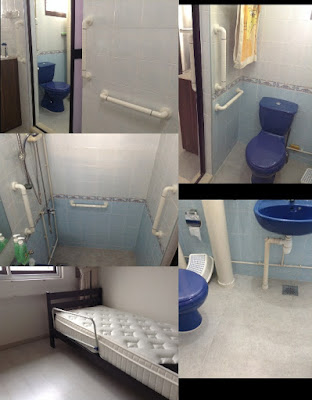
Elderly- friendly home: Safety bars outside and inside the toilet and shower, anti-slip treatment of bathroom flooring, and new beddings with safety handle

We can finally heave a sigh of relief as my first helper is being sent home and we were no longer held liable for any trouble that she might get into (read about my first helper here). Thankfully, we were informed that our second helper will be here within a month.


As mentioned before, we hired a helper to take care of my elderly father-in-law (FIL). If you are interested in our first-hand experience of elderly-parental care - initially, without a helper - this is the article you'll want to read. And why did we hire a maid eventually? What did we actually do everyday as caretakers? What happens in our everyday life as caretakers for an elderly parent, particularly in the context of Singapore? What can you expect to happen? I hope that this article can give you some pointers when you are to take care of your elderly parents one day. 


First, let me tell you about our situation which led us to hire a helper. What made us commit to this long-term and expensive expenditure? Can't the son/daughter or their stay-home wife/husband take care of their parents? A helper can cost you about $1000 a month (monthly pay, pocket money, clothes, daily necessities, dental, medical, insurance, outings, lodging, etc.). This is about the same as the monthly expenditure of owning a car. Here's why...


Throughout the years, my FIL has been whizzed in and out of the hospital about once every year. He would either fall in the bathroom, get a mini stroke, or would suddenly be too weak to move. He had a major stroke more than 10 years ago and is slightly disabled in his left arm and leg and walks about with a walking aid. He stays with his younger son (my hubby's younger brother) in their home in Woodlands, but he only prefers to speak to my hubby and no one else.


Due to this communication hurdle, my husband has to travel from the west of Singapore to the north whenever my FIL has a medical appointment, is being rushed to the hospital, or for any other matters pertaining to my FIL. This went on for the past 15 years. 


But in recent years, FIL's health further deteriorated. Although he has high blood pressure, diabetes, and skin inflammations/bleeding all over his body, he doesn't watch his diet and doesn't take his medications and injections properly. He'll either skip them or finish a whole day's worth of medications in the morning, for convenience sake. And as usual, he eats whatever oily and unhealthy food he wants and whenever he wants, even when the doctors say his health condition is getting worse and he is putting on a lot of weight. 


Eventually, within the span of a year, he went into hospital twice, each time lasting for about 3-4 months because he has gotten so sick and weak. After series of physiotherapies, and weeks of proper diet and medications that he received in the hospital, he started to regain his mobility and health and is eventually send back home. But he'll set out to begin yet another vicious cycle where he'll ignore all advice, continue his unhealthy eating and medication habits, only to get another stroke and be sent to the hospital for months again. 


All this while, my hubby has to rush between his work, the hospital, bringing my FIL to periodic medical appointments at other clinics (eye, skin, urology appts, and etc.) and between the homes in the north and west of Singapore. Day after day, I witness my hubby getting increasingly thin and frail.


I couldn't bear to see my hubby wasting away any further and suggested to bring FIL over to our house and let me take care of him instead, on top of taking care of my then 4-year-old son. So, we foresee that hubby only need to rush between work, home and FIL's routine medical appointments. With me watching FIL's diet and administering his medications properly, he'll have lesser chance of ending up in the hospital again. 


In the meantime, my FIL could also spend quality time with my young boy - the only grandchild that my FIL speaks to and play with. 


Furthermore, my FIL's medical account and all other savings are totally depleted and my hubby has to pay cash in the thousands for each of my FIL's hospital stays. We simply cannot afford to keep paying for this. We're getting very broke. 


And so, we set out to prep our house to be elderly-friendly before bringing FIL over to stay with us. We installed safety bars inside and outside the bathroom (he is given his personal bathroom and bedroom), had the bathroom floor sprayed with anti-slip chemicals, and bought a new comfy bed, drawers, and his personal TV. Finally, we moved his personal belongings from his Woodlands home to our house.


PS: Safety bars around the house, anti-slip floor treatment in the bathrooms and even ramps for wheelchair accessibility can be installed at subsidised rates under EASE programme. You can apply from there. There are also discounts if you want to buy wheelchairs, walking aids, bathroom chairs, etc. Please enquire from your assigned social worker.


By the time FIL arrives at our house, we have already got a well-planned daily routine for him. In the morning, my hubby would bathe him (if FIL wants to) before going to work, and I'll prepare food and medications. In the afternoon, I'll push FIL in his wheelchair and we'll send my son to his 4-hour day school before coming back home for lunch. While FIL takes a nap in the afternoon, I would do the housework, laundry, buy groceries, or run some errands. Then, in the late afternoon, I'll bring FIL to fetch my son and we'll go to the nearby playground and my FIL will enjoy the breeze and outdoors and watch in delight as my son plays with the other kids. Then in the evening, hubby would buy dinner and come back and bathe FIL and administer the needed medications, while I take care of my son. After dinner, all of us would gather in the living room to watch TV and FIL would enjoy watching his grandson playing toys on the floor. This routine went on peacefully for weeks. Until....


One day, FIL wet himself while heading towards the bathroom. He was losing bladder control but did not know it himself. So there was a trail of urine between his bedroom and the bathroom. I quickly did the cleaning up, because apparently, he simply walked over his urine even though I told him to wait. Did he not know (did his cognitive function decreased)? Or he can't hear me? I really don't know. Because, as usual, he was a man of few words. Often, he'll go on for days without uttering a word. When my hubby asked him about it, he too did not answer. Finally, after another few times of such 'accidents', and upon our further probing, he said that he 'kind of' know about it (his losing of bladder control). 


So, every time after I mop off the urine and try to help him change his pants, he adamantly refuse to let me help him in any way and demanded that I leave his room, though in a courteous way. I figured that he's most probably awkward about letting his daughter-in-law (me) help him change. But, what seemed easy (putting on pants) would take him about an hour to accomplish, since he was partially disabled in his left limbs. Sometimes, he didn't want to change at all and goes about the day with the soiled pants on. When we suggested letting him wear diapers, he flatly refused.


One morning, he suddenly vomited while I took him downstairs to shop for his stuff. When we got home, he refused to let me clean him and change his clothes. Never mind! No need, no need (to change), he said to me smilingly.  And so, he wore the soiled clothes until my hubby came back in the evening to bathe him.


And on a few occasions, FIL had diarrhea and soiled his pants but he simply refuse to tell us and went about the day wearing the soiled pants (we'll find out while washing his pants or when we detect a foul smell throughout the house).


This is when the idea of hiring a domestic helper comes in.


We reviewed our financial situation and thought that the next best thing that we could do is to hire a helper to take care of FIL. For one, he may not feel awkward for a helper to change or clean him up, just like how he'll let the nurses in the hospitals clean/change him. And my husband simply couldn't take emergency leave all the time just to rush back to clean him. Most importantly, we just can't let him be in soiled clothes throughout the day, all the time. Also, sending him to a private nursing home would cost at least $2000 - $3000 without subsidy. Mind you, you can only send your parent to the subsidized public nursing home only after fulfilling certain stringent conditions (ask your allocated social worker about this). If you are rich enough, you can send your parent to the more expensive private homes, provided there are vacancies. 


So, the most affordable solution for us is to hire a helper. After the departure of our first terrible Myanmar helper, our second Myanmar helper came 3 weeks later. Let's call her Nin.


Nin is also a new helper with no experience (the information they write in the helpers' resumes, I figured, isn't very truthful/accurate). But thankfully, she's good. She's hardworking, friendly, polite, willing to learn, can speak simple English, does a clean job, can cook well, can play along well with my son and takes care of his safety. Even my FIL likes her a lot, which makes hubby and me very relieved.


Unfortunately, a month later, we have to pay about $600 in total to have one of her wisdom tooth removed (her insurance doesn't cover dental expenses). In fact, we'd actually noticed that her cheeks seemed to be swollen and upon probing, she admitted that she's in pain. Apparently, Nin was already having a toothache during the body check-up in Singapore but she didn't dare to say anything for the fear of losing her job and being send back home. She needed the job to help make ends meet for her family in Myanmar. Since she's been good so far, we paid for all the dental expenses and prayed that she will not quit on us before her 2-year contract ends. 


The initial weeks went pretty well. My hubby supervised Nin in bathing and administering medication to my FIL, and I orientated Nin about our house rules, cleanliness and safety at home (lock window grilles at ALL times), familiarize her to the surrounding areas of our home, initiated her to some of the Singapore culture, adjusted her cooking style (less oily, salty), and I also function mainly as a translator between Nin and my FIL, and etc.


Then something else began to happen. My FIL began to be complacent.


Once, while pushing my son (who is sitting on FIL's wheelchair, on FIL's insistence) towards a small road with an oncoming fast car, my FIL simply refused to stop for the car, insisting that the car should stop for him instead. In my moment of panic, I gathered all my might to pull back the wheelchair with my dearest son in it! (Reminder: my FIL has a big built and is really quite strong). At the next moment, we witness the fast car speeding across us, with no intention to slow down at all. If I weren't there that day, or hadn't stop my FIL in time, my son would have died.


Then, on many instances, while my son was playing his toys on the floor, FIL would suddenly push his wheelchair towards my son, crushing his toys along the way before scaring and cornering my tiny son to a corner, just for the fun of it. What if my son's tiny fingers were on the floor? Wouldn't they be crushed? Once, he even used his huge body weight to crash on my little boy trying to 'play' with him. My hubby was shocked too and deduced that FIL overestimated himself and didn't know that he might hurt his grandson while trying to 'play' with him. We tried explaining to him but our advice was simply brushed aside. Nevermind, it's ok, he'll say laughingly.


In addition to safety, there's another problem: cleanliness. 


One day, out of the blue, my FIL began to resist washing his hands after visiting the bathroom and went on to have his meals and feed my son his share of food with his bare hands. Usually, after his meals, he'll have some food splattered onto his shirt and pants, since he can only use one hand to feed himself. And when we tried to clean him up, he refused flatly, saying that we're such clean freaks and it's not good to be too clean. And so he went on his day switching on/off the light switches, turning door knobs, touching the TV remote controllers and everything else with his unwashed hands. Eventually, on two occasions, our whole family, which includes our helper, my son, hubby, and me, was subsequently down with stomach flu. All of us vomited, and/or had diarrhea and fever for days. The medical bills for the whole family were really getting unbearable.


Sometimes, my ignorant son even picked up FIL's dead skin on the floor to eat! (My FIL has a skin condition where he had bleeding ulcers all over his body and can shed a lot of dead skin, some, in pieces/crusts. Every morning, after he wakes up, we'll have to sweep off his dead skin on his bed or wash the bed sheets altogether.) Moreover, FIL began to revert to his unhealthy eating habits consisting of all sorts of unhealthy snacks, and loads of oily and fatty pork/pig trotters meals which obviously worsens his skin condition - which means more ulcers, more bleeding, and more shedding of dead skin around the house.


By that time, living in our house has become too much to bear. The filthiness throughout the house, the illnesses, the daily stresses and everything else...


That was when hubby and I decided, mainly for the safety and health of our young son, to send FIL back to his own rightful home in Woodlands, where he can be himself and not be restricted in any way by us. Of course, this time, he'll have a personal helper to serve his daily needs - bathing, meal preparations, medications and daily strolls in the park. Besides, there are only adults in the Woodlands home where my hubby's younger brother who is living there with his wife is hardly at home. They work on weekdays and usually visit Johor over the weekend, leaving the house empty most of the time.


Things were fine after the maid and FIL settled down in Woodlands and Nin even mentioned that FIL seems to be in good mood, occasionally whistling and singing to himself and enjoying all his favourite food. Until about six months later, FIL became weaker and couldn't walk anymore. He was eventually admitted to the hospital and has become bedridden.


That's when the doctors advised us to send him to a nursing home as one helper cannot handle him alone. You need at least 2 persons at a time to, say, lift FIL up, in order to clean him. Of course, we cannot afford to have 2 helpers. And this time, with certain conditions fulfilled, we will get a sizeable government subsidy to reduce the cost of the nursing home bills. So, in about a month, FIL was send to a nursing home. We were lucky to get a bed/placement. Just like subsidised childcare in Singapore, there are not many vacancies in our subsidised nursing homes. Sometimes, you have to wait for 3 months.


With my FIL settled at the nursing home, we ceased the services of Nin - our hard working helper, who has been doing a rather good job (with some glitches here and there, but hey, nobody's perfect) - and sent her back to her agency to find another employee since she wants to continue working here in Singapore. PS: If she wants to go back home, we'll have to buy her a one way ticket and send her off at the airport.


Later, we heard Nin found a new employee. I wish her well.


Subsequently, on top of our own family (which includes the whole family of my hubby's brother and sister), we heard that other relatives and old friends of FIL has been visiting him at the nursing home periodically too, making him rather happy. Although he's still the man with few words. And every Sunday, my hubby would visit him and bring him out for a good meal.


Thus, this ends the episode of taking care of one of our elderly parent.


May 20, 2017

My First Myanmar Helper


Back in 2015, hubby and I decided to engage a helper to help me take care of my elderly father-in-law. I have never imagined that I would have the chance to hire a helper, especially when everything here in Singapore is getting so expensive. But it was getting increasingly awkward for me and my FIL as he was resistant about me helping him in his daily living activities like changing of clothes. An external help was needed. And so, we hired a helper on a budget.


But things turned out to be a nightmare rather than a blessing. Let me share with you my first experience of having a helper at home.


We chose a Myanmar (Burmese) helper because they were thought to be more obedient and hardworking (though, they can really eat a lot). Furthermore, most Muslim Indonesian helpers cannot handle pork (my father-in-law's favourite food - although they can actually communicate in Malay with some of our older folks), and Filipino helpers (they have the best command of English) are relatively more expensive.


From the stack of helper profiles that were given by the agency, we randomly chose one of them that we found okay (looked friendly and hardworking). There were no calls or interviews carried out so we relied solely on the information that was written in the resumes: can take care of elderly/children under 5 years, can speak/understand English, can cook Chinese food, etc.


Let's call my first helper Qing. 


Qing first came as a very quiet, timid and nervous girl. She hardly spoke during the first few days and I thought to myself: Great, at least she's not the loud, noisy type.


But, there's only so much that I could take. 


Three weeks on, she still refuses to talk and only answered in seemingly pre-taught standard answers like "Yes ma'm, I understand", or "dirty ma'am". The worse thing is, when I told her that there's no need to be so nervous around us and should relax and speak up more, she began to sing Myanmar songs very loudly and even talked to herself while doing her chores! I tried to command her to stop singing and talking to herself because it's just too weird. She's not here for a vacation but to work for goodness sake. "Yes ma'am, I understand, no sing.. no sing..." she'll reply with a smile but she'll start singing 5 minutes later! So, in the end, I figured that she don't really understand and speak English, unlike what was written in her resume. 


When we ask her to bathe, she went to sit in her room (sorry, but she really has a distinct smell and we realised that she doesn't wash her hair everyday). And when we tell her to eat, she went to wipe the windows. In the following days, we ended up spending our energies trying to get her to understand some simple English words like, bathing, washing, cooking, etc, using the Myanmar translation app on the ipad. It was really a chore. 


Despite all our efforts, her work performance did not improve. She is still forgetful, half-hearted in her work, and she did many other weird things.


She does not do a clean job e.g., cleans half the cupboard or windows only, and is rude to my father-in-law (FIL). I've caught her demanding my FIL to sit down in an offensive manner - with pointy fingers, fierce face and all - and laughed when my FIL tripped and almost fell down.


And when my FIL gets up to pee at night, I always have to call her up to help (my FIL has a rather big build and cannot walk properly). Sometimes I gave up waking her because she's such a good sleeper! No amount of shaking can wake her up. One night, there were fireworks going on near my house and she'd actually slept through that. Goodness.


One morning, I caught her waking up with a face full of makeup. Panda eyes from smudged mascara, powdered face and traces of lipstick and blusher. She literally slept with makeup on - to which she flatly denied. 


I couldn't tolerate all this anymore. Even when you are angry, she can give you her megawatt smile. Once she forgot to lock the window grilles and I scolded her because my then adventurous 4-year-old son may decide to climb out of the window and fall to his death. We're living on the 15th floor so this is no joke. In fact, this is the very first thing I told her when she first came. Qing, you must lock all window grilles, my son may climb out! And to my horror, while I was scolding her, she can still break a cheeky smile at me. I swear I almost feel a stroke coming on. 


Although she is forgetful when it comes to housework, there are things that she'll never forget to do: switch on the TV and watch drama shows everyday (she seems to partially understand Chinese shows), or take a magazine from my stash and read in her bed when she has 'finished' her work. 


When I teach her stuff around the house, e.g., cooking or the laundry, she refuses to learn or put in effort and acted like a princess and so, cannot do all the things I mentioned. I ended up doing a lot of things myself and I feel like I need to take care of her at the same time. She's always admiring herself in the mirror and spends her free time washing her face and neatening her hair as if she's getting ready for a night out. 


There has not been any initiative taken too. Everything needs to be told. Hold the door, press for the lift, look out for cars for my son and FIL, open the door, close window when raining, get a cloth to wipe the mess... it was exhausting, to say the least.


At the end of the month, we allow her to call home and gave her $50 as pocket money to buy her own stuff. The very next day, she suddenly refuses to work, hid in the toilet, and said that she has stomachache and so, requested to go back home to Myanmar. I know she's lying because she simply refused to see a doctor as I suggested.


I've read in the internet that many new and young Myanmar maids come here to 'see the world' and not really to work. Many are as young as 16 years old posing as 25 year olds. This is a good deal as you get the chance to get on the plane and go overseas for the first time to 'see the world' and get paid work at the same time, which includes free food and accommodation. Later, I came to know, if they work in Myanmar for the same work done, they are paid 15-20 Singapore dollars a month. But when they work in Singapore, they get paid at least 500 dollars a month after repaying their initial work loan for the first 4-6 months. That is about 25 times the salary. So, why not try it once in your life? 


And so, on Qing's final day, after having 50 bucks in her pocket, she was bend on quitting and vehemently insisted going straight home on that very day because she's "not feeling well" and even cried as I tried to console her (it appears that she can speak much better English while negotiating to go home). Later, I found out from my Myanmar neighbour, just 2 doors away, that she actually didn't really come here to work but to 'see the world' and wants to go home suddenly because she misses her family.


When she's leaving, she was all smiles and still expected me to open and hold the door for her, and carry her bag. It's ridiculous, considering all the torture she has caused me. Did I hire someone to come and be my little daughter? In any case, I can't wait to send her off for the sake of my sanity.


Since she left, I think my blood pressure returned to their normal levels and I hope she gets her thoughts straightened out before she finds a new employee. 


By the way, my agent at the maid agency said that I was too kind to let her read magazines in her free time even when she did not do her job properly and let her call home thrice within her first month here. No wonder she got lazy, swayed, and quit immediately upon getting her 50 bucks, which is more than 2 months worth of salary back home. 


Subsequently, we paid a small sum of money (50 dollars if I'm not wrong) for the lodging of Qing in the Singapore dormitory while she's getting ready to go home or find another new employee. Meanwhile, we paid for the insurance for a new Myanmar maid that we have (again) randomly chose and await for her arrival in about a month - with our fingers crossed.


PS: The experience with our second Myanmar helper was a blessing! She's hardworking, friendly, can cook well, and can speak simple English. Will tell you about her soon. 😊


Feb 10, 2017

Washing Machine Debate: Front Load Vs Top Load

My Front Load Washing Machine (cum dryer) with high water efficiency (three ticks)

After decades of using top load washing machine, I have finally switched to a front load washing machine.

Despite all the cons I've read on the web about front load machines, I'd decided that I will truly know whether a top load or a front load is better for me, only if I have tried using both of them.

So here I am, after using the front load machine for the first time, for almost two years, and armed with decades of experience in using top load washing machines, let me present to you the pros and cons of using the front and top load washing machines. At the end of the article, I'll also reveal which one I will choose to use permanently and why it is so.


Pros of using top load washing machine
~ You can add in extra clothings to wash, anytime you want, while the machine is in operation. Great if you forgot or missed a clothing.
~ Easy to use as the normal ones have no fancy cycles (eco cleaning, quick wash, etc.) that you have to bother with. Just put in the detergent and press the Start button. Great for beginners, young children, elderly.
~ There is usually no need to maintain the machine. Just clear out any dirt from the dirt collector.
~ Top load washing machine are much cheaper.


Cons of using top load washing machine
~ Clothings are often twisted and entangled together, making them out of shape and wrinkled. Not suitable for delicate clothings.
~ Clothings are still rather wet, even after drying for longer periods of time.
~ Due to the above reason, it is a must to dry your clothings in the sun or air them for at least a few hours, preferably outdoors. If clothes dry too slowly, they tend to emit unpleasant smell. This also means you, or rather, your clothes are at the mercy of the weather. On every laundry day, you'll pray for no rain and lots of sunlight.
~ Top load machines tend to use a lot of water since water level have to cover all the clothings.


Pros of using front load washing machine
~ Very efficient use of water (see pic below), which means you have to use less detergent too. Great for helping to save the environment. I don't buy special "front load detergents", I just use half of the normal "top load detergents". Note: Clothings does not have to be completely submerged in water like the top load machines, thus saving water and detergent.
~ Clothings do not get tangled up
~ The heating function (60 degrees C) makes clothes drier which cuts down drying time. Indoor drying is usually sufficient and leaves no funny smell. Due to heat, clothes came out with less wrinkles which means less ironing to do.
~ The heat (60 degrees C) also kills dust mites and germs.
~ For my 2-in-1 washing machine and dryer, there is a function of drying the clothings to many levels (it's something like 50% - 100% dryness).
~ You can stack/place/build something on top of machine e.g. a wall-hung cabinet thus making full use of space. For me, I keep it clear so as to collect/place/fold my clothes on it - it's like my laundry workspace.


Cons of using front load washing machine
~ Unable to add on additional clothing once you start the washing cycle.
~ There is a need to maintain the machine about once every 2 months. You'll need to remove debris and dirt and drain off excess trapped water. The machine will prompt you to do that.
~ The washing cycles lasts longer (1hr 40 mins for my machine), although there is a 15 mins quick wash function for a small load of laundry. This will depend on the features of individual machines.
~ Front load washing machine are more expensive. But they are more intelligent and efficient.
~ Need to bend or squat down to access the front door which may be unsuitable for the pregnant and elderly.
~ Small children may have dangerous access to the opening of the machine. I have heard children suffocating while hiding inside during a game of hide and seek. Door cannot be opened from within. But I have also seen accidents while child got stuck inside a top load machine. So, whichever machine you use, accidents can happen, you'll just have to keep your eyes peeled to young children.
~ This is from the internet: Machine giving off unpleasant, mouldy smell after a few months of usage. I didn't encounter this at all. But I probably deterred this by keeping the machine doors and detergent tray opened for at least an hour after the end of every single wash to air the insides dry.

See the red box? Water consumption was greatly reduced from 10.9 units in April to 7.6 units in May 2015, the lowest amount of water usage for the past six months. Notice also the electricity usage did not increase. 


My Final Choice: Front Load Washing Machine
I would probably not going to return to using a top load washing machine as the front load machine reduced my water and detergent consumption (thus, less burden to the environment), uses similar amount of electricity, and it churns out drier and straighter clothes (even some doesn't require ironing). But if I have a toddler or very young kid at home (about 0-5 years) I may consider switching back to top load for safety reasons.


Jan 12, 2017

Changing Shirt Collars To Mandarin Collars

It's been really melting hot here in Singapore and all I wanted to wear for an outing is t-shirt and short pants. It's a pity that my beloved button-down shirts haven't been worn for the past few months and are now starting to turn mouldy. This is when an idea popped into my head. 


Cut off the collars so that it does not feel as warm wearing them. ;)


You can do this in 4 simple steps:


1. Cut off the collar very carefully, avoiding the mandarin collar part.


Another example...


2. Wash your shirt in the washing machine so as to expose the loose, fraying threads. 


3. After the wash, manually use your fingers to pull out any leftover loose thread. Then, cut off the loose threads, preferably in good light.


4. Iron them down, preferably in the V-line style so as to visually elongate your torso, making you look slimmer. 
The 'after-shirts'.
They're now much
cooler to wear!


Tip: For the fear of destroying your beloved shirts, you may want to start with your least-loved or the cheapest ones. My shirts above are all bought during sales and cost less than $15. And cut with a sharp scissors - slowly. Also, you can use this same method to change a long sleeve shirt into a sleeveless shirt.


Sep 21, 2016

What To Do With Unwanted Clothes?


Unwanted clothes are:

Too big
Too small
Impulse buys that doesn't fit
Those that you don't like anymore
Not worn for the past 3 years
Worn out
Discoloured


And here's what you can help make full use of them.


1. Wear it for holiday periods. You really wouldn't want to worry about soiling or losing your beloved clothes while having fun or relaxing. Total peace of mind.


2. Too small or big at the waist? Perhaps shifting the buttons further in or out may make the pants wearable again. Good for people who have lost/put on weight, bloating problems or are undergoing pregnancy.


3. Use it for special purposes. Painting the house, spring cleaning, moving house, dirty areas, volunteer work, confinement period, hospital stays, exercise/workout, marathon, etc.


4. Use it for local outing. Beach and poolside lounging, swimming, picnic in the park, outdoor activities, etc.


5. Cut out favourite picture or slogan and frame it up. Whether or not it's Marilyn Monroe or Vincent Van Gogh...

A cut-out from an unwanted old T-shirt


6. Pass down to kids. Why not?? It'll be funny.


7. To wipe very dirty mess. From commercial or industrial to residential mess. Or from infant care up to elderly care.


8. Donate to charity organisations or relatives who don't mind second-hand clothes, especially baby, toddler and children's clothing.


9. For messy hobbies and games. Waterplay with water toys, kid's painting sessions or other art and crafts sessions, trampoline and other active play, Play doh, cake-making or other baking /cooking sessions, etc.


10. Keep for second pregnancy- as mommy's post-pregnancy clothes or pass down kids' clothings to your second or third child.


11. Wrap around glass and other fragile, sharp or metallic items in the storeroom.


12. Keep as mementos. Just for the sweet memories. I kept my firstborn's onesies nicely in a ziplock bag.


13. Use it as part of your furniture. For inner pillow cover, chair/car seat cover, massager chair seat cover, stool seat cover, or to wrap around any type of furniture. Bigger socks can be used to house unused gadgets and electronics (wrap unused handphones and chargers in socks). Smaller socks can be used as a chair or table leg protector to reduce dragging.


May 3, 2016

Home Renovation Tips


I couldn't be happier when my hubby told me that I have the full rein to do up our entire empty new home. The home that I have in mind is comfy and cosy, one that allows the occupants to remove themselves from their hectic day and be fully relaxed. This should be our private sanctuary that each of us can retreat to at the end of the day. The world is really getting so overpopulated already. We really need a proper and peaceful home where we can wind down and recharge our batteries. 


I think that home design should be, as far as possible, both user-friendly plus practical (Function) and pleasing to the eyes (Form). 


A home design with good function will have an efficient layout in terms of clever usage of space and arrangement/design of furniture according to the layout and its users' living habits. The user experience should be pleasant and, if possible, effortless. In short, the home design should serve its intended purpose (or function) well.


Whereas for form, the end-design of the home should be aesthetically pleasing to the users. The chosen colours, design and materials for the walls, floorings, fittings, cupboard and counters should not only look great but also achieve its intended visual effect to the users. Example, if the home is designed to look airy and spacious, light or bright colours should be used, furniture can be hung on the walls and they should not block any natural sunlight coming in from the windows.


Do not give up one for another. A home design with great function (or practicality) may be easy to use but it will affect the overall user experience if it's in an awkward colour or an outdated design. Likewise, a home design that looks really great but is not user-friendly (impractical, e.g. needs high maintenance) may bring on unnecessary frustration and, in the long run, poor user experience.


Other than function and form, below are the things that I'll be looking out for, in the design of my new home. Many of them stem from the lessons that I've learnt, through the hard way from the renovations of my first home. Ain't gonna make the same mistakes again. Hope they'll be useful to you.


1. Try to find an interior designer who has at least a basic knowledge of feng shui. There's no point living in a fantastic looking home which you feel uncomfortable in. (For my basic feng shui tips, read here.)


2. If you're doing up stark white cabinets, do them in the same material/colour and preferably from the same source. Different ones may end up 'ageing' with different tones of white which can look unsightly. This advice came from hubby's friend who regretted mixing build in white cabinets with loose, store-bought white cabinets. If he had known, he would choose to build all his white cabinets from the same source.


3. Do up the window grilles before you move in! If you are space-starved with no gardens or balconies, the window grills is the perfect place to occasionally air and sun your pillows or stuffed toys. More importantly, installing the window grills will take away the fear that your child may accidentally fall off the window. In Singapore, where most of the people live in high-rise buildings, there are news of kids falling to their death from their flat almost every year. This is a serious matter. If you haven't done it, do it NOW. Better be late than be sorry.


4. If you are a clean freak like me, make sure the design and products are easy to clean and maintain. Avoid hard-to-reach nooks and crannies, easily-stained materials and other homewares that needs frequent hands-on care. For this, I will not be installing doors with carvings. And I'm also not going to buy tables with grooves or gaps - especially for the dining table. Can't imagine removing food debris from the grooves after every meal.
It's a chore to clean the dust off these door grooves all the time.
Both front and back!


5. Finding the local interior design scene getting predictable and common? Can't seem to find the exact design theme that you want?

For interior inspirations, check out the home designs from other countries, especially those with similar home size. For land-scarce Singapore, we can look to our counterparts in Hong Kong and Japan and even Taiwan for some fresh ideas. Check them out either through online interior design websites (Hey! Cheese photography, super love the gorgeous homes in this Taiwan website), online magazine (try ISSUU.com), new condominium launches, or even hotel booking websites e.g. agoda.com or booking.com. Yes, I am crazy like this ;) . Note: check out kid's theme park hotels for kid's room design ideas. And get snapshots of design photos that you love and show them to your interior designer or contractor in due course.


6. Decide on the main colours that you'll be using for your entire home (usually 3 main colours). If the colours are uncoordinated, it can look very messy and the occupants may not feel at ease. Remember to ask yourself, "Can I live with this every single day?"


7. Do not build an opened walk-in wardrobe near the entrance of the bathroom. The moisture from the bathroom will turn your clothes mouldy and smelly and no amount of moisture absorber works. Get them closed up with doors or build them in another room. I will definitely not build a walk-in wardrobe again because the opened shelves get so dusty everyday. I do not want to clean my wardrobe all the time. They are supposed to serve me, not the other way round.


8. Stick floor paddings to legs of movable furniture to reduce dragging and to protect both the furniture and the floorings while doing housework. Your neighbour downstairs and upstairs will thank you for being considerate too.


9. If you can't decide on a design theme, keep the house design minimal and stick to neutral colours first. You can always spruce it up to your favourite theme with changeable and add-on items like pillows, curtains, furniture, paintings, pictures and other decorative homewares.


10. Never ever construct aircon pipes underneath a built-in wooden platform or structure. The condensation of the pipings will create an enclosed niche area for termites to thrive (wood + moisture = termites. Learnt this the hard way). Also, build the aircon pipings near the ceilings as opposed to near the floor as they directly take up floor space! A great bane for the already space-starved flats.


11. A sequel to the previous point (see no. 11): I will not use any laminate flooring again. The good thing about laminates which I did for my bedroom flooring and platform bed is that it is cosy, comfortable and quite cheap. But as years passed, they started to warp/expand/contract in all places and has created lots of unevenness and gaps. It's also tiring to keep the surface dry at all times - not easy with kids, on rainy days and when mopping the floor. It's so tiring! Feels like I'm servicing the floor all the time. Not worth it. More so, I don't want to meet anymore flying termites ever again!
My headaches...
Above: Cheap and ugly link between laminates and tiles.
Below: Gaps of skirtings that termites can live in.


12. Do not place your computer screens directly opposite windows. It'll reflect the sunlight from the windows and cause a distracting glare.


13. I will not use pebbles in my house ever again. They are difficult to clean - I have to spray-wash, and the stones fall out all the time. They also attracted a lot of insects. I did it for the bathroom floor and it attracted hundreds of tiny insects within days and I have to remove and redo the whole flooring immediately!


14. I will not want a balcony again. I enjoyed it for the first few years but later, when all the cleaning took its toll on my blistering hands, I begin to find it a real hassle to clean the balcony floor, its furniture, and the full height glass sliding doors. You can consider if you have a maid.


Before you countersign on the final blueprint of your home renovation, take a step back and visualise you and your family members actually living in the new home. What do you all usually do together at home? What are some of your more prominent habits or lifestyle? Do you have a collection of things that need proper storage? E.g. Bags, shoes, hats, camera equipments, or toys? And based on these, have you fully utilised each precious room that you have? If you have pets, where will they hang out/eat/sleep? If your family loves reading, is there a cosy place to do just that? Or is there at least an area that you can house the family's book collection?


"In the end, we should create a house that fits our lifestyle and works for us. Not the other way round."